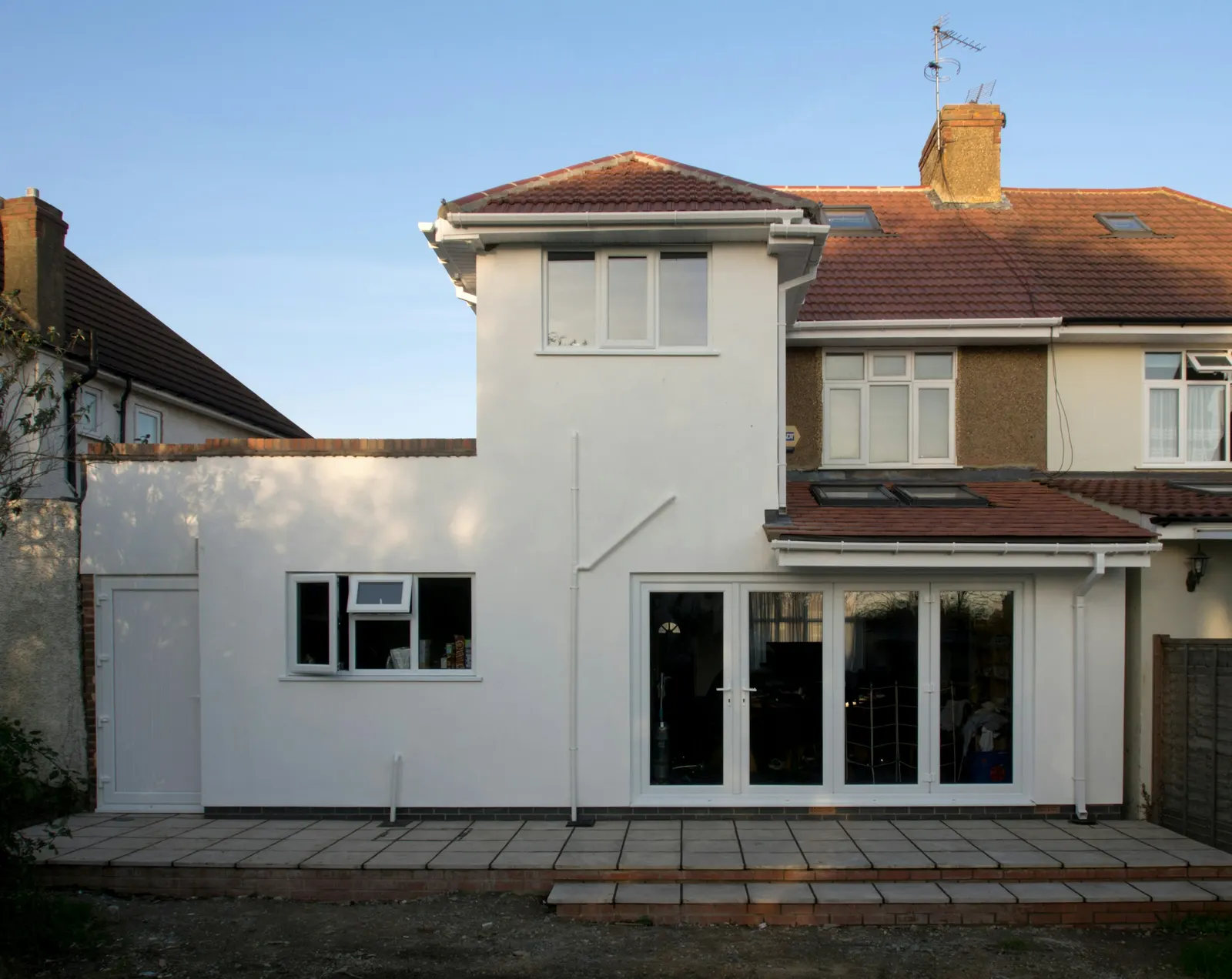
Amending an approved planning permission in London
Plans move after approval: the builder finds a drain in the wrong place, a window wants to be wider, the neighbour's wall is not where the survey said. Building to different drawings from the ones approved puts the permission at risk. We redraw the change, work out which route fits, and apply for it, for a fixed £295.
Fixed fee from £295 · all prices
Prefer to talk it through?
Three routes, and why the choice matters
Once planning permission is granted, you must build in accordance with the approved drawings and conditions. When something has to change, there are three ways to ask. A non-material amendment is for changes small enough that they do not change the substance of the permission. A section 73 application changes or removes the conditions attached to it. Anything bigger is a fresh planning application.
Choosing wrongly costs time. Ask for a non-material amendment when the change is in fact material and the council refuses it after the full wait. Go to a full application for something that was a trivial tweak and you pay the full fee and wait the full period. The Planning Practice Guidance sets out the three options, and our first job is to match your change to the right one.
Planning Amendments
from £295
Every price is the full fixed fee you pay. No VAT is charged. Council application fees are paid to the council separately.
What you get
- A comparison of the approved drawings with what you now want to build
- A straight answer on the route: non-material amendment, section 73 variation or new application
- Revised drawings with the changes clearly marked
- The application form and a short description of the change
- Submission to the council as your agent, with replies to the officer
- A plain note of what to do if the council says the change is too big
- Compare the drawings
We lay the approved plans over your revised ones and list every difference, however small.
- Pick the route
Small and harmless goes as a non-material amendment; a change to conditions goes under section 73; a bigger change is a new application.
- Redraw
The changed drawings, with the old and new positions marked so the officer sees exactly what moves.
- Apply
Submitted to the council with the correct fee, quoting the original permission number.
- Decision
A non-material amendment has a 28 day target. We chase it and tell you when you can build.
What counts as non-material
There is no tidy rule. The guidance says there is no statutory definition of non-material, because it depends on the context of the overall scheme: an amendment that is non-material in one context may be material in another. The council must be satisfied that the change is non-material before it can grant one under section 96A.
In practice that means a window moved 300 millimetres on a rear elevation is a different question from a dormer made 300 millimetres taller on a street with a strong roofline, and a different question again from a change that touches a neighbour's boundary. We tell you how the council is likely to read it, using decisions on its register, and we do not promise something the officer controls.
The guidance states that the procedure cannot be used to make non-material amendments to listed building consents.
How long it takes and what it costs
For a non-material amendment the guidance gives a determination period of 28 days, or a longer one agreed in writing. There is no statutory consultation, and the council has discretion whether to tell anyone. From 1 April 2026 the council's fee is £46 for householder development and £309 in any other case.
A section 73 application is a different animal. Its council fee is £89 for householder development and £608 in most other cases. A new householder planning application costs £548 in fees. All of these are paid to the council, separately from our fee.
Section 73: changing the conditions, not the scheme
Section 73 can look like a handy back door for changing the design. It is narrower. The guidance says the change must only relate to conditions and not to the operative part of the permission, and that it cannot be used to change the description of the development. It is the route when a condition names the approved drawings and you want a different set, for example, or when a condition restricts hours or materials you want to vary.
The result is also a different kind of document. A section 73 grant takes effect as a new, independent permission to carry out the same development subject to new or amended conditions, sitting alongside the original, which remains intact. That is useful, but it means the council re-issues every condition, and we read them all again before you accept it.

Two things that do not qualify
The non-material route is only for planning permissions. The guidance states that the procedure cannot be used to make non-material amendments to listed building consents. If your house is listed and the change affects the consent as well, the consent needs its own application. We cover that in our listed building consent drawings service.
And the route does not rescue work already built differently. If the building has gone up to the revised design, the question is no longer an amendment. It is a retrospective application, and the sooner you stop to check, the more room you have. See retrospective planning applications.
What our fixed fee covers
A fixed £295 is the total you pay, with no VAT charged. It covers the comparison, the redrawn sheets, the form and the submission, plus the officer's follow-up questions. If your change needs a new application, we say so before you spend more, and the fee for the larger job is quoted separately.
Send the planning reference, your revised sketch and the reason for the change. If the builder is waiting on a decision, say so, and we will look at that first.
Sources
Every figure on this page, where it comes from and a link to the original.
| Figure | Source | Link |
|---|---|---|
| 28 days | Planning Practice Guidance, Flexible options for planning permissions, para 007: (source wording: "The time period for determination is 28 days, or a longer period if that has been agreed in writing") | www.gov.uk |
| no statutory definition | Planning Practice Guidance, Flexible options for planning permissions, para 002: (source wording: "There is no statutory definition of ‘non-material’") | www.gov.uk |
| £46 | Statutory fee from 1 April 2026: non-material changes to planning permission, where the application relates to householder development | assets.publishing.service.gov.uk |
| £309 | Statutory fee from 1 April 2026: non-material changes to planning permission, in any other case | assets.publishing.service.gov.uk |
| £89 | Statutory fee from 1 April 2026: removal or variation of a condition (section 73), where the application relates to a householder application | assets.publishing.service.gov.uk |
| £608 | Statutory fee from 1 April 2026: removal or variation of a condition (section 73), in any other case (not householder, not major development) | assets.publishing.service.gov.uk |
| operative part | Planning Practice Guidance, Flexible options for planning permissions, para 013: there is no statutory limit on the degree of change to conditions under s73 (source wording: "the change must only relate to conditions and not to the operative part of the permission") | www.gov.uk |
| new, independent permission | Planning Practice Guidance, Flexible options for planning permissions, para 015: (source wording: "takes effect as a new, independent permission") | www.gov.uk |
| listed building consents | Planning Practice Guidance, Flexible options for planning permissions, para 004: (source wording: "cannot be used to make non-material amendments to listed building consents") | www.gov.uk |
| £548 | Statutory fee from 1 April 2026: householder planning application, Sch 1 Pt 2 category 6(1) | assets.publishing.service.gov.uk |