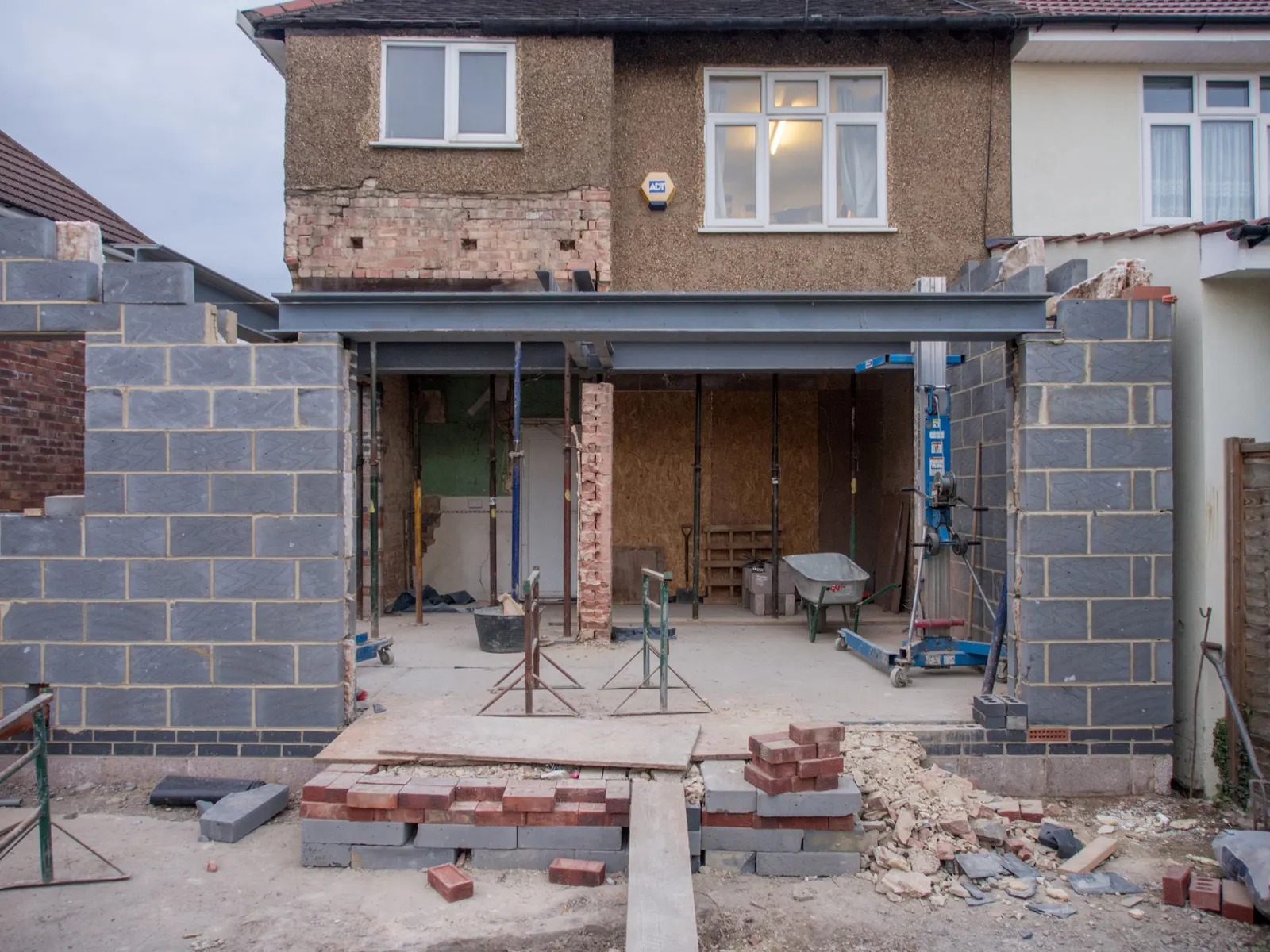
Retrospective planning application for work already built in London
If an extension, outbuilding, loft or change of use has gone up without the permission it needed, the usual way out is to ask for that permission now. We survey what is actually there, draw it as built, check it against the policies your council will use, and make the application for you, for a fixed £695 with the survey visit included.
Fixed fee from £495 drawings + £200 survey (£695 total) · all prices
Prefer to talk it through?
How the law lets you ask afterwards
The Town and Country Planning Act deals with building first and asking later head-on. Section 73A says that on an application to a council, the permission which may be granted includes permission for development carried out before the date of the application. It covers work done with no permission, work done against a time-limited permission and work that broke a condition.
That is the whole basis of a retrospective application. It is not an amnesty and not a formality. Government guidance warns that it cannot be assumed that permission will be granted, and the application must be considered in the normal way, against the same policies as any other.
Retrospective Planning Applications
from £695
£495 drawings + £200 survey (£695 total)
Every price is the full fixed fee you pay. No VAT is charged. Council application fees are paid to the council separately.
What you get
- A measured as-built survey of the building and the unauthorised work
- Existing, as-built and (if it helps) amended drawings to scale
- A short written explanation of what was built and why it is acceptable
- Site plan, location plan and the application forms
- Submission to the council as your agent, with replies to its questions
- A straight view on the chances and on cheaper routes before you commit
- Check the clocks
We find out when the work was finished and whether the council can still act, or whether a lawful development certificate is the better route.
- Survey as built
We measure what is really there, because old plans and the building rarely agree.
- Test against policy
We read the local plan and design guides the case officer will use, and say where the work is weak.
- Apply to the council
A normal planning application for development already carried out, sent in by us as your agent.
- Decision or appeal
If the council refuses, we explain the 12-week appeal route and what is realistic.
You get one go, so the first application has to be right
This is the point owners most often miss. The same guidance says a person who has carried out unauthorised development has only one opportunity to obtain planning permission after the event, either by a retrospective application or by appealing an enforcement notice on the ground that permission ought to be granted. If the council has already issued an enforcement notice, it can decline to determine a retrospective application at all.
So we do not fire in a quick set of drawings and hope. We measure the work, test it against the local plan and the borough's design guidance and tell you plainly where it is weak. If a modest change, such as lowering a roof line, trimming a depth or swapping a material, would turn a likely refusal into an approval, that change is better made before the application than after the refusal.

If an application is refused, a householder appeal is open for up to 12 weeks.
The two clocks: 4 years and 10 years
Councils cannot act on every breach forever. Under section 171B, in most cases development becomes immune from enforcement after a fixed time. For operational development, such as a building or an extension, finished on or after 25 April 2024, that time is 10 years from substantial completion. For work substantially finished before that date, it is 4 years. A change of use to a single dwelling follows the same split.
If your work is old enough to be immune, a retrospective application may be the wrong tool. A lawful development certificate records that the work is lawful, without the council judging whether it is good design. We work out the dates with you on the first call, because the answer changes which service you buy.
Sometimes it was permitted development all along
Sometimes the work never needed permission. Permitted development rights are measured limits, on depth, height, volume and distance from the boundary, and a house owner who built to what they believed was the limit may well have kept inside it. Only a measured survey can tell, because a figure remembered from the builder is not evidence.
If the work does fit, a certificate is the route, not a planning application. If it overshoots a limit, we say by how much and whether a small alteration would bring it back inside. Either answer is better to hear from us than from an enforcement letter.

If the council has already written to you
A council that spots unauthorised work may send a letter, an enforcement warning notice or, later, an enforcement notice. The guidance describes the warning notice as the way a council may invite a retrospective application. Treat any of these as a deadline. Send us the letter and the address the same day and we will tell you which clock is running.
An enforcement notice carries its own appeal window and cannot be ignored. Our guide to planning enforcement in London explains the notices in order, and our retrospective permission guide covers what councils weigh. If an application is refused, a householder appeal is open for up to 12 weeks.
Loose ends: building regulations and CIL
Planning permission does not cover building regulations. Work done without them can be put right with a regularisation certificate, and we use the same survey for both, so you are not paying for two sets of measuring.
One more thing to know. In areas that charge the Community Infrastructure Levy, the guidance notes that a retrospective permission can mean losing a relief or exemption that applied to an earlier permission. Where that could affect you, we raise it before you apply. The council's application fee is separate from ours, and the householder fee from 1 April 2026 is £548. Our fixed fee is £695, the total you pay, with no VAT charged.
Sources
Every figure on this page, where it comes from and a link to the original.
| Figure | Source | Link |
|---|---|---|
| carried out before the date of the application | Town and Country Planning Act 1990 s.73A(1): on an application the permission which may be granted includes permission for development carried out before the date of the application (source wording: "carried out before the date of the application") | www.legislation.gov.uk |
| cannot be assumed that permission will be granted | Planning Practice Guidance, Enforcement and post-permission matters: although a council may invite an application (source wording: "it cannot be assumed that permission will be granted") | www.gov.uk |
| only one opportunity | Planning Practice Guidance, Enforcement and post-permission matters, restrictions on retrospective applications (source wording: "only one opportunity to obtain planning permission after the event") | www.gov.uk |
| decline to determine | Planning Practice Guidance, Enforcement and post-permission matters: the council can decline to determine a retrospective application if an enforcement notice has previously been issued, under section 70C (source wording: "decline to determine a retrospective planning application") | www.gov.uk |
| 10 years | Planning Practice Guidance, Enforcement and post-permission matters, time limits (s.171B): immunity (source wording: "within 10 years of substantial completion" for operational development completed on or after 25 April 2024) | www.gov.uk |
| 4 years | Planning Practice Guidance, Enforcement and post-permission matters, time limits (s.171B): immunity (source wording: "within 4 years of substantial completion" for operational development completed before 25 April 2024) | www.gov.uk |
| relief or exemption | Planning Practice Guidance, Enforcement and post-permission matters: in CIL charging areas a retrospective permission can result in the (source wording: "loss of any relief or exemption") | www.gov.uk |
| 12 weeks | GOV.UK, Appeal against a householder planning decision: if your application was refused you can appeal (source wording: "up to 12 weeks from the date on the decision letter") | www.gov.uk |
| £548 | Statutory fee from 1 April 2026: householder planning application, Sch 1 Pt 2 category 6(1) | assets.publishing.service.gov.uk |