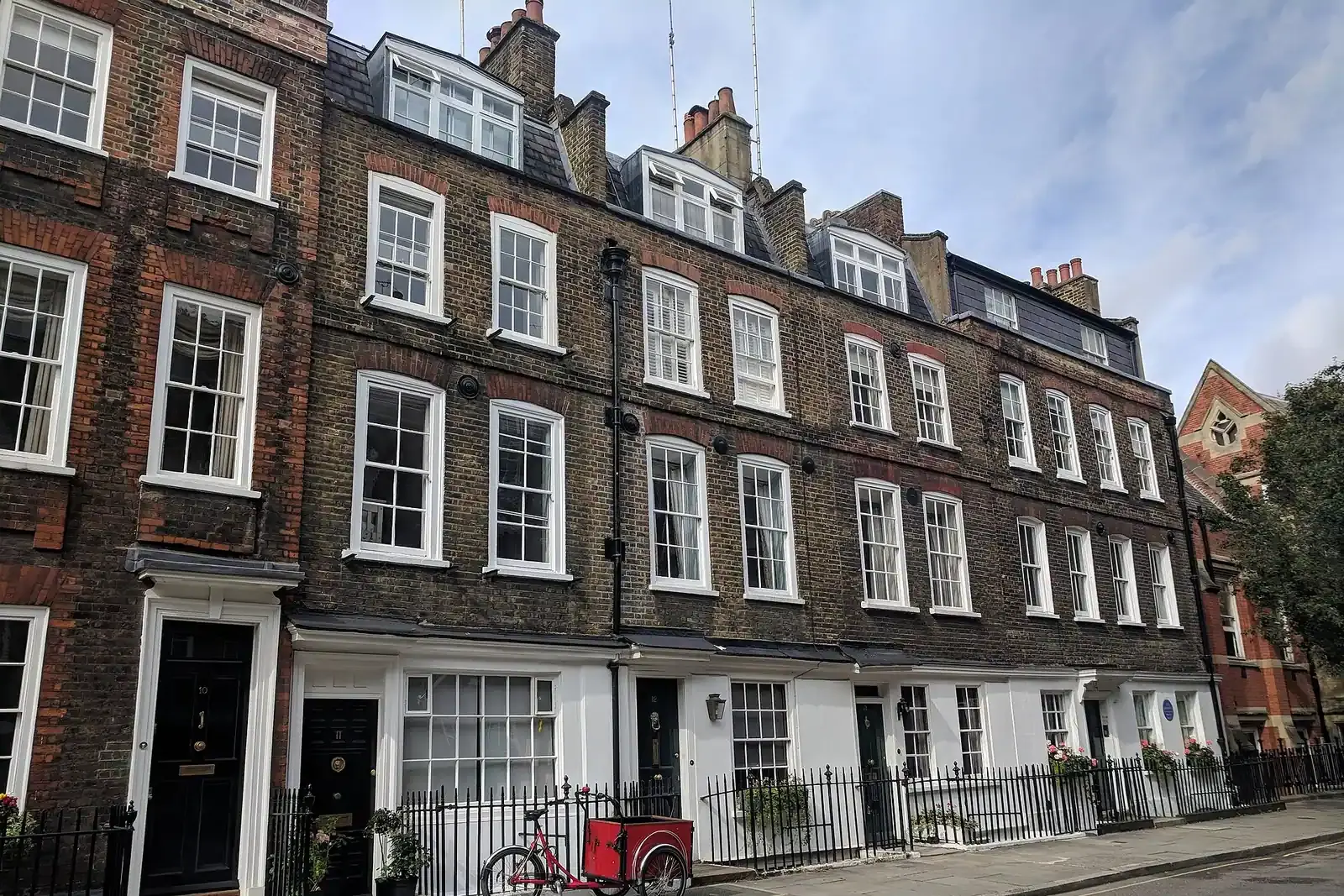
Certificate of lawful existing use for London homes
A certificate of lawful existing use (a CLEUD) is the council's written confirmation that something already there, an extension, a loft, a conversion into flats or a use of the building, can no longer be enforced against. It is for the owner who needs proof of that, perhaps for a sale or a lender. We visit and measure the property, assemble the evidence, draw what exists and make the application, for a fixed £950 with the survey visit included.
Fixed fee from £750 drawings + £200 survey (£950 total) · all prices
Prefer to talk it through?
What a certificate of lawful existing use settles
The certificate is issued under section 191 of the Town and Country Planning Act 1990. The Act treats uses and operations as lawful if no enforcement action may then be taken in respect of them, because they did not need permission or because the time for enforcement has run out. Planning merits play no part: the council is not asked whether it likes what is there, only whether it is lawful.
That is why the certificate suits an owner whose home carries an old change that nobody ever regularised: an extension added without permission, a loft converted years ago, a house divided into flats, a garage used as a home. Our guidance on retrospective planning applications covers the other route, for work that is too recent to qualify.
Certificate of Lawful Existing Use
from £950
£750 drawings + £200 survey (£950 total)
Every price is the full fixed fee you pay. No VAT is charged. Council application fees are paid to the council separately.
What you get
- A measured survey visit to the property
- Existing floor plans, elevations and site plan drawn to scale
- A precise written description of the use or works being certified
- A schedule of evidence, with each item dated and sourced
- Draft declarations for the people who can swear to the history
- The application made to your council as your agent, with replies to its questions
- Drawings, evidence and application
- £750
- Measured survey visit
- £200
- Council fee (house alterations)
- £548
- Total
- £1,498
The time limits: four years became ten
Whether something has become lawful by passing of time depends on section 171B. For building and other operations in England, no enforcement action may be taken after ten years beginning with the date the operations were substantially completed. A change of use of a building to a single dwellinghouse has ten years beginning with the date of the breach, and so does any other breach of planning control (a house divided into flats, for example).
Until recently the period for operations and for a change to a single dwellinghouse was four years. Section 115 of the Levelling-up and Regeneration Act 2023 replaced the words from four years onwards, and the change was brought into force on 25 April 2024 by S.I. 2024/452. Wales kept four years.
The change does not reach back. Under regulation 5 of that instrument, the new periods do not apply where the operations were substantially completed, or the change of use occurred, before 25 April 2024. Those older breaches stay on the four-year clock they started on. An extension finished in 2019 is on the four-year clock, which ran out in 2023, so a certificate may be available now. One finished in June 2024 is on the ten-year clock, and the earliest date is 2034.
Section 191(3A) adds one more point: the time for enforcement is taken not to have expired while a planning enforcement order can still be applied for. A period that looks finished may not be, so we check the history before we advise you to apply.
For an existing use or operation, the MHCLG fee schedule from 1 April 2026 sets the fee at the same as the full application fee for the matching planning application.
The evidence a council needs
The burden is on you. The planning practice guidance on lawful development certificates says the applicant is responsible for providing sufficient information. If the council has no evidence of its own to contradict yours, there is no good reason to refuse a certificate, provided your evidence alone is sufficiently precise and unambiguous to justify one on the balance of probability. Precision matters more than volume.
Good evidence is dated and independent of the person applying: aerial and street imagery that shows the work in place on a known date, council tax and utility records, tenancy agreements, invoices from the builder, building control completion certificates, dated photographs, and statements from people who were there. We list each item, say what it proves and note the gaps, so you can see where the case is strong and where it is thin before the council does.
Councils often ask for sworn declarations from owners, neighbours or tradespeople. We draft them. They have to be sworn in front of a solicitor or other person authorised to administer oaths, who charges their own fee; that fee is not ours and is not in the price. We do not write evidence for people and we never tidy a history. The guidance is blunt that a certificate can be revoked if a statement was made or a document used that was false or untrue in any way, or if any information was withheld.
What we measure and draw
The certificate has to describe precisely what is being certified, so the drawings matter. On the survey visit we measure the house and garden, photograph the work from the angles an officer will want, and note what is original and what was added. We then draw the existing plans and elevations to scale and write the description of the use or operations in the words the certificate will carry.
A vague description gives a vague certificate. A certificate that says only that the house is a dwelling does little for a sale; one that sets out the rooms, the extension footprint and the number of self-contained homes does. If your property is split into flats, the number of units, their layout and the dates they were first let go into the description.

The council fee
The council fee is separate from ours and is paid to the council. For an existing use or operation, the MHCLG fee schedule from 1 April 2026 sets the fee at the same as the full application fee for the matching planning application. For alterations to a single house that is the householder fee of £548, the figure shown in the cost bar above. For a use of land or a building it is the fee for that kind of application, and your council will confirm the exact figure before you pay.
Our fee is £950 in total with the survey visit included, and no VAT is charged. If the property needs a proposed-use certificate instead, for work you have not yet built, see lawful development certificate drawings.
If the council refuses
A refusal is not necessarily conclusive that something is not lawful. The guidance says it may only mean that, so far, not enough evidence has been presented, and another application can be made when more is found. There is also a right of appeal against a refusal in certain circumstances. We tell you at the start how strong we think the evidence is, and we say plainly if we think it is not yet enough.
If the right answer is a planning application instead, because the work is recent or the evidence will not stretch, we say that too. We would rather you spent £950 on the right route than on the wrong one.
Sources
Every figure on this page, where it comes from and a link to the original.
| Figure | Source | Link |
|---|---|---|
| no enforcement action may then be taken | Town and Country Planning Act 1990 s191(2): uses and operations are lawful if (source wording: "no enforcement action may then be taken in respect of them") | www.legislation.gov.uk |
| ten years | Town and Country Planning Act 1990 s171B(1)(a), as amended for England: no enforcement action for building or other operations after (source wording: "ten years beginning with the date on which the operations were substantially completed") | www.legislation.gov.uk |
| ten years beginning with the date of the breach | Town and Country Planning Act 1990 s171B(2)(a) and (3), as amended for England: change of use of a building to a single dwellinghouse, and any other breach, ten years beginning with the date of the breach | www.legislation.gov.uk |
| 25 April 2024 | Levelling-up and Regeneration Act 2023 s115 (time limits for enforcement) came into force on (source wording: "25th April 2024") under S.I. 2024/452 reg 3(b) | www.legislation.gov.uk |
| four years | Levelling-up and Regeneration Act 2023 s115(1)-(2) replaced, in s171B(1) and (2) of the 1990 Act, (source wording: "the words from 'four years' to the end") with ten years for England; Wales keeps four years | www.legislation.gov.uk |
| before 25 April 2024 | S.I. 2024/452 reg 5: the s115 amendments do not apply where operations were substantially completed, or the change of use occurred, (source wording: "before the day on which that section comes into force") | www.legislation.gov.uk |
| balance of probability | Planning Practice Guidance, Lawful development certificates, paragraph 006: with no contrary evidence from the authority or others, the applicant's own evidence can justify a certificate if (source wording: "sufficiently precise and unambiguous to justify the grant of a certificate on the balance of probability") | www.gov.uk |
| false or untrue | Planning Practice Guidance, Lawful development certificates, paragraph 012: a certificate can be revoked if (source wording: "a statement was made, or document used, which was false or untrue in any way; or if any information was withheld") | www.gov.uk |
| same as the full application fee | Fees for planning applications in England from 1 April 2026 (MHCLG), certificates of lawful use or development: existing use or operation, fee payable (source wording: "Same as Full Application fee") | assets.publishing.service.gov.uk |
| £548 | Fees for planning applications in England from 1 April 2026 (MHCLG): householder application to enlarge, improve or alter a single dwellinghouse (source wording: "single dwellinghouse, £548") | assets.publishing.service.gov.uk |
Questions people ask
Do I need a certificate of lawful existing use to sell my house?
How old does the work have to be?
Who swears the declarations?
What if I do not have much evidence?
Is this the same as a planning application?
Photographs: Richard Symonds (CC BY-SA 4.0).
