Planning and building regulation drawings in Bloomsbury (WC1E)
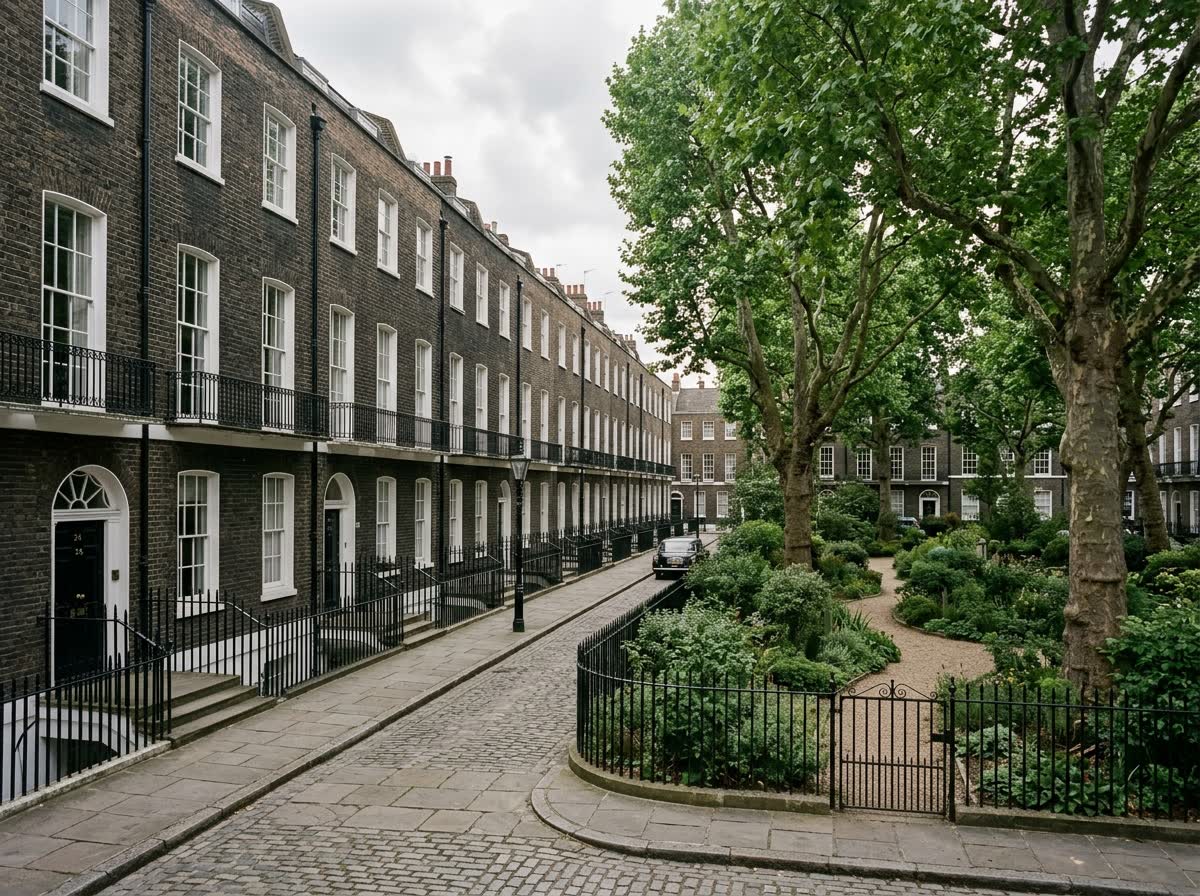
Bloomsbury is a formal Georgian townscape. Terraces of brown and yellow stock brick frame the garden squares, and Bedford Square, Montague Street, Store Street and Great Russell Street are among its streets. Many of the buildings are in university, institutional or office use, with homes on the upper floors, and a high proportion are statutorily listed as well as lying within a conservation area. For a homeowner, that combination shapes nearly every decision: the first question is what may be altered at all, before how much can be added.
- MCIAT chartered technologists
- London Borough of Camden granted 88% of 404 householder applications
- Drawings in about 7 days
Projects here therefore tend to be careful. Work to the rear and the roof is controlled because the setting of the square and the visible skyline are protected, and anything visible from the square is scrutinised closely. Work here can include refurbishing an upper-floor flat, reconfiguring an interior, repairing or replacing windows, or converting a floor between office and residential use. Where a building is listed, listed building consent is needed alongside any planning permission for works affecting its character, and it can reach internal works as well as external ones. Like-for-like repair is not development, which helps with maintenance, but the difference between repair and alteration should be settled before work starts.
Change of use is a sensitive subject where university, museum and institutional uses are so concentrated. The Bloomsbury conservation area is the main designation, and Fitzroy Square and Charlotte Street are also Camden conservation areas to the west. Flats have no householder permitted development rights, and the practical limit on what a leaseholder can do often comes from the lease and the freeholder, even though a planning application itself needs only the correct ownership certificate or notice. Camden also asks for a Basement Impact Assessment for below-ground works. We check the listing and the designations first.
Planning in Bloomsbury: what to know before you apply
Conservation designations reach across most of Camden and listed buildings are numerous, so a homeowner here should not assume permitted development applies. Bloomsbury adds the formal garden-square setting, which tightens control of rear and roof additions and of anything visible from the square. Camden also operates a demanding basement policy: a scheme that creates or extends a basement or lower-ground floor generally needs a Basement Impact Assessment covering structural stability, drainage and groundwater. Listed building consent is a separate permission from planning. Residential conversion of institutional or office floors is treated as a sensitive change of use. We confirm the exact constraints on your address before drawing.
Applications are decided by London Borough of Camden — its planning pages.
Does your Bloomsbury project need planning permission?
Bloomsbury (WC1E) in numbers
What London Borough of Camden has decided, and what WC1E is built of — the two facts that shape every job here.
Householder planning decisions — London Borough of Camden
Bloomsbury (WC1E) applications are decided by London Borough of Camden; these are its published householder figures for the last four quarters.
| Householder applications decided2025 Q2 to 2026 Q1 | 404 |
|---|---|
| Granted | 357 |
| Refused | 47 |
| Grantedof 404 decisions · England 90% | 88% |
| Decided within 8 weeksof 230, excluding prior approvals | 87% |
Source: Ministry of Housing, Communities and Local Government (PS2 district planning application statistics). Open Government Licence v3.0 Extracted 2026-09-22.
Permitted development prior approvals — London Borough of Camden
How the larger-home-extension route has fared with London Borough of Camden, which decides WC1E notifications.
| Larger home extension prior approvals — not required2024 Q2 to 2026 Q1 | 1 |
|---|---|
| Prior approval granted | 6 |
| Prior approval refused | 1 |
Source: Ministry of Housing, Communities and Local Government (PS1 district planning application statistics). Open Government Licence v3.0 Extracted 2026-09-22.
Planning appeals — London Borough of Camden
Refusals in WC1E can be appealed to the Planning Inspectorate; this is London Borough of Camden's householder appeal record.
| Householder appeals determined2021–2026 | 119 |
|---|---|
| Allowed | 38 |
| Allowedof 119 · England 36% | 32% |
Source: Planning Inspectorate appeals casework. Open Government Licence v3.0 Extracted 2026-09-22.
Conservation areas and Article 4 directions — London Borough of Camden
Register counts for London Borough of Camden. A count describes what the council has published, never a rank against another council.
| Conservation areas in the register40 dated, 1968–2008 | 40 |
|---|---|
| Article 4 directions in the register | 21 |
| Areas covered by an Article 4 direction | 21 |
Source: MHCLG Planning Data Platform. Open Government Licence v3.0 Extracted 2026-09-22.
- Day 0Measured survey of your Bloomsbury property — or your existing plans if you have them.
- About 7 daysDrawings issued for your approval. Free redraws until you are happy.
- SubmissionWe validate against London Borough of Camden’s checklist and submit on your behalf.
- Council: 8-week targetHouseholder applications carry an 8-week statutory target. London Borough of Camden decided 87% of 230 recent householder applications inside it.
Source: Ministry of Housing, Communities and Local Government (PS2 district planning application statistics). Open Government Licence v3.0 Extracted 2026-09-22.
Streets and neighbourhoods in WC1E
Bloomsbury (WC1E) — FAQs
Do I need consent to change a window in a Bloomsbury flat?+
Can I dig out a basement under a Bloomsbury house?+
Get your free Bloomsbury planning assessment
Tell us your WC1E address and ambition — feasibility, constraints and a fixed fee within one working day.